

The purpose of our show is to bring information and solutions to issues that impact the day-to-day lives of minorities.We can bring this value add by leveraging the knowledge of our host, Walter Latham, Sr. , co host Ernest Robinson, Marine Sergeant (Ret) , Briggette Stokes former teacher (ret). and subject matter experts where necessary.
Episodes

Mar 31, 2026
Mar 31, 2026
54 min
In part 2 of our interview with Edmond W. Davis, we discuss the upcoming annual event National HBCU Black Wall Street Career Fest!
Building Bridges at the HBCU Wall Street Festival. Join us in this engaging episode featuring Professor Edmond W. Davis from Arkansas, who shares insights on the groundbreaking National HBCU Black Wall Street Career Fest. Discover how this innovative event fosters collaboration, showcases diverse opportunities, and empowers students to succeed beyond traditional pathways.
Main Topics Covered:
- The evolution and growth of the HBCU Wall Street Festival over five years
- The role of collaboration over competition among HBCUs and community partners
- The significance of career exposure, skill development, and entrepreneurship for students
- Strategies for outreach, vendor engagement, and securing sponsorships
- The importance of community involvement, volunteerism, and intergenerational support
- The impact of notable figures and funding sources supporting HBCU initiatives
- Future visions for expanding the reach nationally and fostering regional partnerships
Timestamps:
- (00:02) - Welcome and introduction to the HBCU Wall Street Festival
- (02:42) - Explaining the CPR Career Positioning Resource
- (03:45) - Details on the festival dates and participating HBCUs
- (05:39) - The festival's goal of exposing students to diverse career pathways
- (09:03) - Emphasizing skilled trades such as plumbing, welding, and HVAC
- (10:08) - Current vendor engagement and outreach efforts
- (12:05) - Collaborations with local universities and community organizations
- (15:11) - The importance of competition versus collaboration among HBCUs
- (18:23) - The marginalized funding and resource challenges faced by HBCUs
- (22:36) - Recent sponsorship acquisitions and fundraising efforts
- (26:52) - Vision for growth: expanding to 20 states by 2027
- (28:19) - Regional engagement, travel considerations, and partnership opportunities
- (39:11) - Event logistics: venue, media, and promotional strategies
- (44:32) - The unique "Podium Promise" for vendor speakers
- (45:51) - How to register for the event via Eventbrite
- (46:20) - The integration of AI and technology in the festival
- (50:23) - Inspiring stories of student success and entrepreneurship
- (54:52) - Preparing students for a rapidly changing workforce
- (55:34) - The importance of continuous learning and community support
Resources & Links:
- National HBCU Black Wall Street Career Fest — Register for the event
- HBCU Wall Street Festival Official Site
- Edmond W. Davis on LinkedIn
- Arkansas Baptist College
- Topgolf
- Dave & Buster’s
- Morgan State University
- Julian Bond Archive
- Mackenzie Scott’s Philanthropy
Connect with Professor Edmond W. Davis:
This episode underscores the power of unity, strategic partnerships, and innovative programming to uplift HBCUs and their students. Tune in to learn how to get involved and support the future leaders shaping our communities.

Mar 24, 2026
Mar 24, 2026
14 min
In this episode, Walt shares his early experiences arriving in New York City, navigating unfamiliar environments, and the lessons learned about trust and street life as a young man from North Carolina.
Keywords New York City, life lessons, trust, street life, young immigrant, North Carolina, subway, homelessness, personal growth
Key Topics
- First impressions of New York City
- Trust and deception on the streets
- Street life and homelessness
- Adapting to urban environments
- Lessons learned from street encounters
Guest Name
titles
- Lessons from a Young Man’s First Days in New York City
- Navigating Trust and Street Life: A Personal Journey
Sound Bites
- "I wondered how white people really felt."
- "Trust is the key thing here."
- "You have to be very careful in New York
Link to Chapter 1:
https://podcasts.apple.com/us/podcast/the-walt-weekly-podcast/id1459801934?i=1000453508781

Mar 16, 2026
Mar 16, 2026
13 min
Special Release!
Due to the fast oving news on ths war, we are releasing this episode one day early.
This episode delves into the geopolitical tensions surrounding Iran, examining both the military implications and economic consequences, especially concerning U.S. foreign policy and military action. Insights are provided from a seasoned finance expert and a critical perspective on leadership and strategic decisions.
Main Topics Covered:
- The significance of Iran's military actions and their implications
- global military strategy
- Economic impacts of conflicts, including rising gas prices and supply chain concerns
- leadership, including the White House and military commanders
- The role of Israel and regional land disputes as part of broader geopolitical interests
- The importance of understanding nuclear treaty agreements and the potential consequences of their breakdown
- Historical perspectives on military conflicts and theories on U.
- technological stagnation
Key Insights:
- The military actions, or perceived lack thereof, highlight ongoing "forever wars" involving Iran, Iraq, and Afghanistan
- The conflict risks triggering a draft and escalating regional tensions, especially over land and real estate disputes involving Israel
- Economic signals point to rising fuel costs and inflation due to wartime disruptions
- leadership is criticized for lack of gravitas and strategic clarity, with particular disdain for Pentagon officials' confidence levels
- Historical and modern perspectives illustrate how leadership and inventions impact global power dynamics
- The episode emphasizes skepticism over official narratives, urging listeners to question political motives and media portrayals
Resources & Links:
- Middle East Policy](https://www.cfr.org)
- Strait of Hormuz - Strategic Significance
- [Analysis of U.
- Military Spending](https://www.washingtonpost.com)
Connect with the Host:
- Apple Podcast
- Google Play
- YouTube Channel

Mar 10, 2026
Mar 10, 2026
16 min
As is normal when you come from a small town, you can’t wait to leave. Take my word for it, my town was small and people went to bed after dark. I used to go down to the bus station and watch friends and relatives taking that 8:15 to New York. Finally, my turn came.
Please Subscribe, Like, Follow and Share

Mar 3, 2026
Mar 3, 2026
5 min
- Tariffs are essentially a tax that consumers pay.
- The average American family has lost significant money due to tariffs.
- China's trade surplus remains substantial despite US tariffs.
- Trump's tariffs did not effectively reduce the trade deficit with China.
- The host emphasizes the need for leverage in trade negotiations.
- Education and continuous learning are crucial for success in any field.
- The podcast aims to provide value to the black community.
- Listener engagement is important for the podcast's visibility.
- The host's journey in financial services began with a music scholarship.
- Competing effectively requires dedication and hard work.
Tariffs usually hurt consumers overall by raising prices, reducing choice, and lowering real income, even though they may help some protected industries.shapiro+2
Contact Us:
Walter.Latham@thewalweekly.com
Youtube.com/Thewaltweeklypodcast
Feb 24, 2026
Feb 24, 2026
53 min
We think a lookback to our podcast from Sept. 2022 is applicable to today's events.
In a paper done by the National Information Forum, The “great replacement” theory, in simple terms, states that welcoming immigration policies — particularly those impacting nonwhite immigrants — are part of a plot designed to undermine or “replace” the political power and culture of white people living in Western countries.
America is struggling with its reasoning and responses to population replacement, or the “great replacement” theory. Like so many demographic issues, the composition of America’s population has become highly politicized, partisan and divisive.
Promoted by racist, antisemitic, xenophobic and white supremacist groups and spread by some media outlets, the great replacement is a conspiracy theory about changes in the composition of America’s population. The great replacement theory centers on the belief that nonwhite, non-Christian people are being brought to America for the purpose of replacing the white Christian majority population in order to establish a new political and socio-cultural agenda.
It has moved from the fringe of racist political movements to become prominent in American politics. A recent poll found that 61 percent of Americans who voted for former President Trump agree with the idea behind the great replacement theory

Feb 17, 2026
Feb 17, 2026
37 min
This is Part 1 of a 2 part interview.
In this episode of The Walt Weekly Podcast, host Walt and co-host Ernest J. Robinson welcome Edmond W. Davis, a world-class speaker, historian, and professor. The conversation delves into Davis's background, his advocacy for teaching history from an Afrocentric perspective, and the importance of HBCUs in empowering African American students. Davis discusses the alarming rates of violence among African American males and the need for community education and empowerment. The episode also touches on the role of media in shaping narratives about black communities and concludes with a discussion about the upcoming HBCU Black Wall Street Career Fest, aimed at connecting students with job opportunities.
Keywords
Edmond W. Davis, history, violence prevention, HBCU, education, advocacy, black history, community empowerment, media representation, career fest, Grambling, Louisiana Tech, Black Fratricide, Negro Removal Plan, Tribe
Important Links:

Feb 10, 2026
Feb 10, 2026
11 min
Summary
This episode discusses the significant demographic shifts occurring in the U.S., particularly the decline of the non-Hispanic white population and its implications for society and politics. The host explores the reasons behind this decline, the potential extinction of the white demographic, and the impact on black communities and their political leverage. The conversation emphasizes the importance of understanding these changes in the context of political representation and societal dynamics.
Takeaways
The non-Hispanic white population in the U.S. has been declining for years.
By 2060, the white population is projected to be only 45%.
The decline is attributed to an aging population and social issues.
Black populations are stable or growing, contrasting with white decline.
Demographics influence political power and representation.
Black communities must leverage their voting power effectively.
The first drop in the white population occurred between 2010 and 2020.
Demographic changes will affect policy decisions and funding.
The host encourages listeners to be aware of these shifts.
The podcast aims to raise awareness about demographic and political issues.
Keywords
demographics, population decline, white population, political implications, immigration, black leverage, societal changes
Feb 3, 2026
Feb 3, 2026
13 min
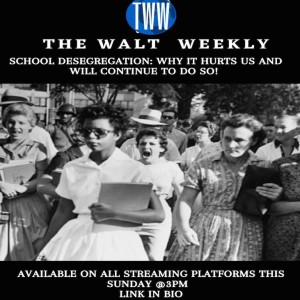
This episode of The Walt Weekly discusses the impact of integration on the Black community in the United States. The host argues that integration has not been beneficial and has led to the decline of black businesses, the black family unit, and black education. The need for people of color to recognize the negative effects of integration and focus on building wealth and creating their own businesses is emphasized. The episode also highlights the lack of black educators and the importance of representation in the classroom.
Keywords integration, black community, black businesses, black family unit, black education, wealth creation, black educators, representation
takeaways
- Integration has not been beneficial to the Black community in the United States.
- The decline of black businesses, the black family unit, and black education can be attributed to integration.
- People of color should focus on building wealth and creating their own businesses.
- The lack of black educators and representation in the classroom negatively impacts black students.
titles
- The Decline of the Black Family Unit
- Building Wealth and Creating Black Businesses
Sound Bites
- "What has integration done for you?"
- "On average, white people have seven times more wealth than we do."
- "We need wealth that we can pass on to our kids, our grandkids, our great grandkids."
Chapters
00:00The Negative Impact of Integration on the Black Community
03:49Building Wealth and Creating Black Businesses
08:19The Decline of the Black Family Unit
11:56The Importance of Black Educators and Representation in Education

Jan 27, 2026
Jan 27, 2026
5 min
Keywords Nicki Minaj, cultural identity, Black Americans, immigrant activism, unity, division, foundational Black Americans, cultural autopsies, social commentary, community respect, Delineation, Sun Tzu
Summary In this episode of the Walt Weekly Podcast, Walter Latham discusses the implications of Nicki Minaj's recent statements at a conservative political event, exploring the deeper connections to foundational Black American identity and the rift between Black Americans and immigrant communities. He emphasizes the importance of acknowledgment and respect among different Black cultures while warning against the dangers of division and the historical strategy of 'divide and conquer.'
takeaways
- Cultural autopsies provide deeper insights than celebrity gossip.
- Nicki Minaj's comments sparked significant cultural discussions.
- Foundational Black American identity is distinct and important.
- Acknowledgment from immigrant communities is crucial.
- Division among Black communities plays into historical traps.
- Unity is essential for progress and recognition.
- Cultural respect should be mutual among all Black groups.
- The concept of 'divide and conquer' is still relevant today.
- Strategic thinking is necessary to avoid historical mistakes.
- Celebrity actions can reflect broader cultural issues.